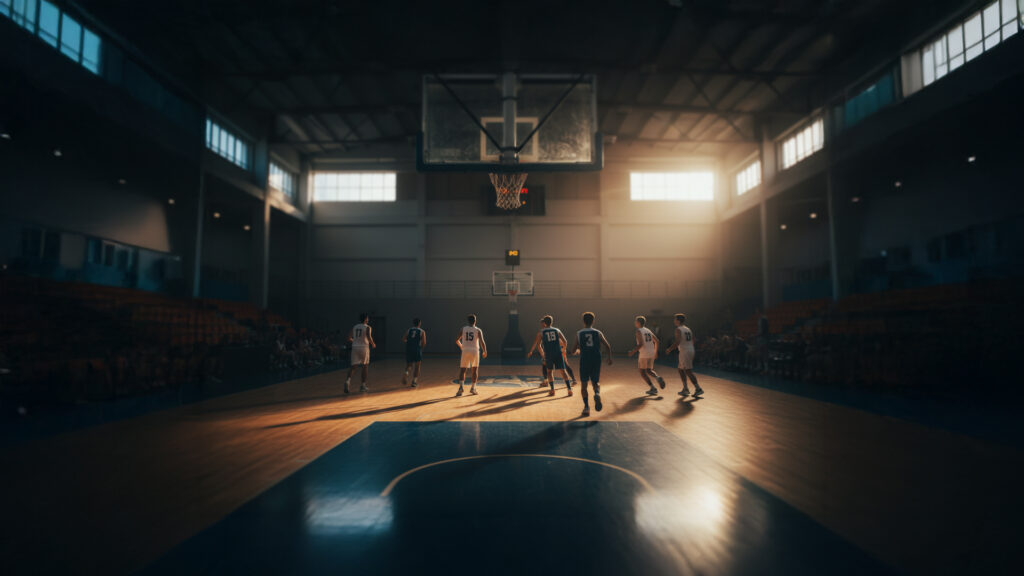
Indoor sports photography is one of the most frustrating challenges photographers face. Gyms, rinks, and indoor courts combine fast action with poor light, mixed color temperatures, and backgrounds that constantly change. Unlike outdoor sports, you cannot rely on sunlight or predictable conditions. Every venue is different, and many are simply dark.
This post focuses on practical, repeatable settings that work in real indoor sports environments. You will learn how to prioritize shutter speed, why Auto ISO is often the correct choice, and how to make peace with noise by planning for it in post-processing. The goal is not perfection at capture. The goal is sharp, usable images that freeze action and tell the story of the game.
Why Indoor Sports Are So Difficult to Photograph
Indoor venues create three main technical problems at the same time:
Low and Inconsistent Light
Most gyms are lit for human eyes, not cameras. Light levels are often several stops lower than daylight and can vary across the floor. Some areas may be usable, while others are nearly unusable. Indoor gyms are a textbook example of the kinds of challenges discussed in my guide to photographing places you cannot control.
Fast and Unpredictable Motion
Sports require fast shutter speeds. A basketball player driving to the hoop or a volleyball spike does not slow down because the gym is dark.
Artificial Lighting Issues
Many indoor venues use sodium vapor, mercury vapor, or mixed LED lighting. These cause color shifts, banding at certain shutter speeds, and inconsistent white balance from frame to frame.
Because of this combination, compromises are unavoidable. The key is choosing the right compromises.
The Core Camera Settings for Indoor Sports
Shutter Speed Comes First
Shutter speed is non-negotiable. If the action is blurred, the photo fails regardless of how clean it looks. If you need a refresher on how shutter speed, aperture, and ISO work together, see my post Exposure Triangle Explained for a clear breakdown.
General starting points:
- Basketball, volleyball, hockey: 1/640 to 1/1000
- Gymnastics or dance: 1/500 to 1/800
- Youth sports with slower motion: 1/400 to 1/640
If you must choose between a noisy sharp image and a clean blurry one, always choose sharp.
Aperture: Wide Is Normal Indoors
Indoor sports are one of the few genres where shooting wide open is standard practice, not a weakness.
- f/2.8 on zoom lenses is common
- f/1.8 or f/1.4 primes are often ideal
Depth of field is already shallow at close distances, but motion matters more than background separation. Missed focus is a technique issue, not an aperture issue.
Auto ISO Is the Correct Tool Indoors
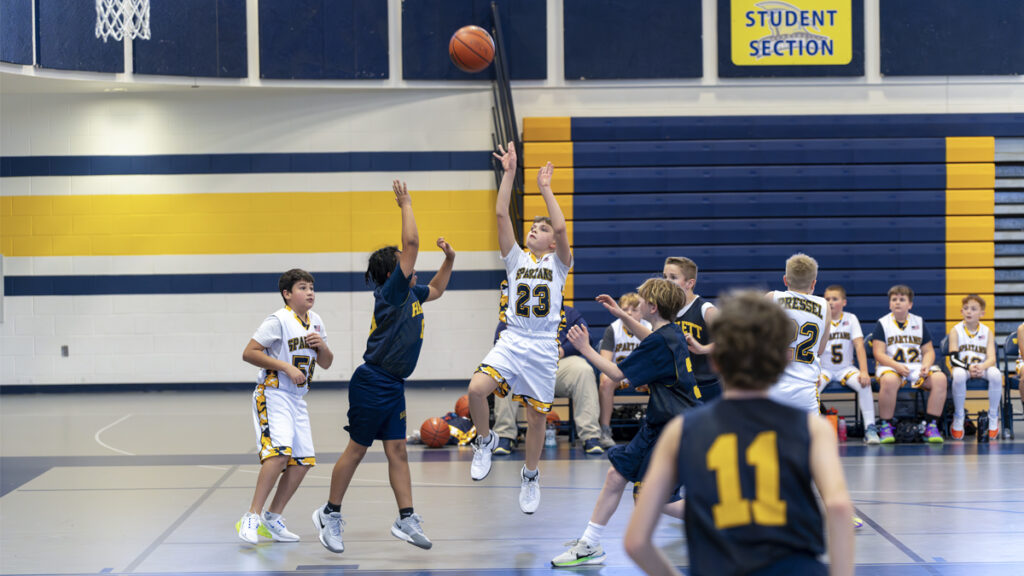
This is the most important point of the post.
Auto ISO allows you to:
- Lock in a required shutter speed
- Keep aperture constant
- Let the camera adapt instantly to changing light
Indoor sports lighting changes as players move, referees block lights, or the action shifts to darker areas of the court. Manual ISO cannot react fast enough.
Recommended setup:
- Manual or Shutter Priority mode
- Fixed shutter speed
- Fixed aperture
- Auto ISO with a defined maximum
Typical maximum ISO limits:
- Modern full-frame: ISO 6400 to 12800
- Modern APS-C: ISO 3200 to 6400
The exact number depends on your tolerance for noise and your post-processing workflow.
Why Noise Is Acceptable (and Blur Is Not)
Noise can be reduced. Motion blur cannot.
Modern noise reduction tools are extremely effective when used intentionally. If your image is sharp and well exposed, noise is far less visible after processing than you might expect.
Important practical notes:
- Slight overexposure reduces visible noise
- Underexposed images pushed in post look far worse
- Grain is less noticeable in action shots than in portraits
If your workflow includes noise reduction in Lightroom, DxO, or similar tools, Auto ISO becomes an advantage rather than a risk.
Nikon also explains why indoor sports photography requires prioritizing shutter speed over low ISO when working in challenging gym lighting.
Autofocus and Drive Settings That Matter
Continuous Autofocus Is Mandatory
Use continuous AF modes that track movement rather than refocus for each frame.
Key priorities:
- Continuous AF (AF-C or AI Servo)
- Subject tracking if your camera handles it well
- Single point or small zone for consistency
Avoid large auto area modes if your camera struggles with background distractions.
High Burst Rate Helps Timing
Indoor sports benefit from short bursts rather than single shots.
- Use high-speed continuous drive
- Shoot in short controlled bursts
- Avoid holding the shutter endlessly
Burst mode increases keeper rate during peak action moments like jumps, hits, or blocks.
White Balance and Flicker Considerations
Manual White Balance Often Works Better
Auto white balance can shift dramatically under artificial lights.
Better options:
- Set a manual Kelvin value
- Use a custom white balance if allowed before the game
- Adjust in post using a neutral reference
Flicker Reduction Helps in Some Venues
If your camera supports flicker reduction or anti-flicker shooting, enable it. This can reduce exposure and color variation caused by cycling lights, especially at faster shutter speeds.
Positioning and Anticipation Indoors
Good settings do not fix bad positioning.
Practical positioning tips:
- Stay near corners or baselines when possible
- Watch player patterns rather than reacting late
- Anticipate peak moments, not constant motion
Indoor sports reward anticipation more than reflexes. Knowing where action will happen matters more than chasing where it already is.
Common Indoor Sports Photography Mistakes
- Prioritizing low ISO over sharpness
- Shooting manual ISO in changing light
- Using shutter speeds that are too slow
- Expecting perfect color straight out of camera
- Standing too far from the action
Most missed shots indoors come from trying to keep ISO low instead of keeping shutter speed high.
Indoor sports photography requires a mindset shift. You are not chasing clean files. You are chasing sharp moments under difficult light. Auto ISO is not a compromise. It is a tool that allows you to control what actually matters: shutter speed and timing.
By locking in your exposure priorities and accepting manageable noise, you dramatically increase your keeper rate and reduce missed moments. With modern cameras and post-processing tools, noise is a solvable problem. Blur is not.
Once you embrace this approach, indoor sports photography becomes far less frustrating and far more consistent.